Hemp Unveiled: Beyond the Buzz
Welcome to the world of hemp, a versatile and sustainable marvel that’s been making waves in various industries. Hemp, scientifically known as Cannabis sativa, has often been misunderstood due to its association with marijuana. However, it’s time to unveil the true potential and benefits of this remarkable plant.
- The Nutritional Powerhouse:
Hemp is not just an industrial crop; it’s a nutritional powerhouse. Hemp seeds, in particular, are a rich source of plant-based protein, containing all essential amino acids. Packed with omega-3 and omega-6 fatty acids, hemp seeds offer a well-balanced ratio that supports heart health and overall well-being [1]. With an impressive nutrient profile, hemp is gaining recognition as a superfood. - Versatility Unleashed:
One of the most captivating aspects of hemp lies in its versatility. From textiles and paper to food and biofuel, hemp can do it all. Hemp fibers are incredibly strong and durable, making them ideal for sustainable textiles [2]. Meanwhile, hemp seeds and oil are finding their way into kitchens, adding a nutty flavor and nutritional boost to a variety of dishes. - Sustainable Wonder:
Hemp is a champion of sustainability. Unlike many crops, hemp requires minimal pesticides and herbicides, making it an environmentally friendly choice for farmers [3]. It’s also a rapid carbon dioxide absorber, contributing to carbon sequestration. With a short growth cycle, hemp can be cultivated multiple times a year, further enhancing its sustainability credentials. - Growth and Agriculture Facts:
Hemp is a hardy crop that can thrive in diverse climates. It requires less water than traditional crops like cotton and can grow in various soil types [4]. In fact, hemp has been used in crop rotation to improve soil health. Its deep roots help prevent soil erosion and improve soil structure. - Breaking the Stigma:
It’s crucial to distinguish hemp from its psychoactive cousin, marijuana. Hemp contains negligible levels of THC (tetrahydrocannabinol), the compound responsible for the “high” associated with marijuana. The 2018 Farm Bill in the United States legalized the cultivation of industrial hemp, recognizing its non-intoxicating nature and potential economic benefits.
Hemp’s journey from a misunderstood plant to a celebrated and sustainable resource is well underway. As we embrace its nutritional, versatile, and eco-friendly attributes, the future of hemp looks promising.
Sources:
[1] Callaway, J. C. (2004). Hempseed as a nutritional resource: An overview. Euphytica, 140(1-2), 65-72.
[2] Li, H. L. (1974). An archaeological and historical account of cannabis in China. Economic Botany, 28(4), 437-448.
[3] Small, E., & Marcus, D. (2002). Hemp: A new crop with new uses for North America. In Trends in new crops and new uses (pp. 284-326). ASHS Press.
[4] Clarke, R. C., & Merlin, M. D. (2013). Cannabis: Evolution and ethnobotany. University of California Press.
Elevate Your Baked Goods: The Power of Hemp Protein
Elevate Your Baked Goods: The Power of Hemp Protein
In the realm of plant-based baking, Nepra Foods continues to redefine the game with its revolutionary use of hemp protein in baked goods. As the culinary world evolves, so do the ingredients that shape our favorite treats, and hemp protein emerges as a powerhouse for both nutrition and taste.
Hemp protein, a key ingredient in Nepra Foods’ innovative approach, is derived from the seeds of the non-psychoactive cannabis sativa plant. This unique protein source not only provides a substantial boost in protein content but also offers a complete plant protein profile, boasting all 20 essential amino acids.
One remarkable aspect of Nepra’s hemp protein is its meticulous processing. Unlike traditional hemp flours that often retain a green hue and grassy flavor due to the inclusion of hemp hulls, Nepra Foods takes it a step further by dehulling the hemp seeds before the milling process. This refinement not only enhances the purity of the flour but also results in a pristine white hemp protein, setting it apart from its counterparts in the market.
The significance of incorporating hemp protein into baked goods extends beyond its nutritional profile. Nepra Foods acknowledges the challenge faced by those seeking gluten and allergen-free options, especially in the realm of plant-based products. Hemp protein, being naturally gluten and allergen-free, serves as an elegant solution to address this gap, ensuring that everyone can indulge in delicious baked goods without compromising on health.
For avid bakers looking to enhance the nutritional content of their creations, Nepra Foods’ R&D team provides valuable insights on incorporating hemp protein into recipes. Whether it’s adjusting proportions or exploring new techniques, the team at Nepra Foods is committed to empowering individuals to make healthier choices without sacrificing the joy of indulgent treats.
As the culinary landscape continues to embrace plant-based alternatives, Nepra Foods stands at the forefront, championing the use of hemp protein to elevate the nutritional value of baked goods. Join us on this journey of transforming ordinary treats into extraordinary, nutrient-packed delights. Your taste buds and well-being will thank you.
Hemp Protein 101
Hemp Protein 101
Since the passing of the 2018 Farm Bill & the release of hemp from its categorization with marijuana, manufacturers & food scientists across the country finally received the “green” light they’ve been waiting for. In the food world, hemp research & development is actively unlocking new horizons with vast health benefits & companies like Nepra Foods are bringing these revolutionary plant-based products into the spotlight.
One of Nepra’s pillar ingredients, hemp heart protein flour, is made from the seeds of the non-psychoactive cannabis sativa plant. Carefully dehulled & milled to the finest purity, this product naturally yields around 16g protein per ¼ cup (30g) serving & is a complete plant protein; it contains all 20 amino acids, with the golden ratio of Omega 3 to 6 fatty acids – all of which are integral to our body’s optimum wellness. [2]
Historically, milling hemp seeds into flour creates a green colored product with a noticeably grassy flavor – this is largely due to the hemp hulls (the hard, outer casing of the seed) being included in the blending process. With the aim to craft a cleaner product, Nepra Foods has refined the hemp flour milling process by dehulling the hemp seed prior to manufacturing. The dehulling process improves the quality of the flour (& any subsequent oil pressed from the seed) by removing any tannins that may affect color & taste. With the hull removed & the raw seed milled, Nepra Foods has been able to create a pure, white hemp flour. Check out Our Process here!
Because Nepra Food’s hemp heart flour is naturally gluten & allergen free, it offers an elegant solution to the general lack of protein found in plant-based, gluten & allergen free products on the market today. When gluten is removed from its natural source, a deficiency is created that must be filled with a secondary protein. Hemp Heart Flour, however, is the full package.
When adding Hemp Heart Flour into any baked good or bread it is important to take the residual fat content into account. The R&D team at Nepra Foods can provide tips and tricks on how to replace some of the flour in your recipe with hemp flour to enhance the nutrition and protein content.
Sourcing: (1.) https://neprafoods.com/mission/
What the HEMP?
What the Hemp?
Historically, hemp has been largely misunderstood. This non-intoxicating variety of the cannabis species is a fast-growing plant, known for its variety of sustainable textile applications; recently we have seen incredible innovations with hemp as food, sought after for its high protein count & amino acid content.
Versatility aside, “hemp is a more sustainable…and regenerative agricultural crop, & most everything you can make with cotton or soy, or corn can be made with hemp – with way less impact on the Earth,” says Hemp Promoter & Earth Advocate Morris Beegle(1).
So with such a regenerative & nutritious plant, why has it taken so long for hemp to enter the mainstream?
It all started with the Marihuana Tax Act of 1937 – the first set of imposed regulations placed on the psychoactive variety of the plant – and by the 1970 Comprehensive Drug Abuse Prevention & Control Act, Hemp had been lumped into the same category as marijuana.
This Act dictated that hemp & marijuana would be treated similarly, in the eyes of the law – even though hemp has no tetrahydrocannabinol present in its natural state. Guilty by association.
It took a full 44 years until the 2014 Farm Bill opened the door for newly informed discussions to take place surrounding the difference between marijuana & hemp. By the 2018 Farm Bill, hemp was finally released from its categorization with marijuana.
Only in recent years have farmers been able to cultivate hemp without fear – with its quick growing season, drought tolerance & ability to sequester carbon, we are only beginning to scratch the surface of what hemp can do for the environment.
Sourcing: (1.) Quote by Morris Beegle, in Parletta, Natalie “Could Hemp Be The Next Big Thing in Sustainable Cotton, Fuel, Wood & Plastic?” Jun. 28th 2019. Forbes.
How Does HEMP Stack Up?
Hemp Seed Oil v.s. Other Seed Oils (Pt.1)
The first part of the Nutrition Series, Hemp Seed Oil v.s. Other Seed Oils, focuses on the complex nature of seed oils and gets into the details of why all seed oils aren’t created equal…
First and foremost, let’s recap how Hemp Seed Oil is extracted and how it’s different from other ‘hemp-derived’ products out there like CBD. Hemp oil is not the same thing as hemp seed oil. Put simply, hemp seed oil is made by cold pressing the seeds of the hemp plant, whereas hemp oil is made by extracting the oils from the hemp flower and stalk. If you want to learn more about the difference between the two check out our series: “The Anatomy of the Hemp Seed.”
The use of oil, specific to cooking and food processing, began thousands of years ago, with the help of whatever food materials they had in hand to make oils for cooking purposes. It all started when people learned to use fire and a makeshift oven to heat oily plant products until the plants exuded oil that could then be extracted. The emergence of Soy oil dates as early as 2000 B.C. by the Chinese and the Japanese, while the Southern Europeans had begun to produce olive oil by 3000 B.C.[1] As time passed, many other plants and vegetables were being used for their precious oil.
But have you ever wondered which cooking oil is healthiest?
There’s canola oil, olive oil, and sunflower oil, even hazelnut, avocado, and apricot kernel oil. But each oil has a unique composition of fats and is manufactured in different ways. Some cooking enthusiasts will say that the healthiest oil is the one with the most omega-3s. Others warn against too much chemical processing and opt for “virgin” oils. [2]
But where does Hemp Seed Oil stack up?
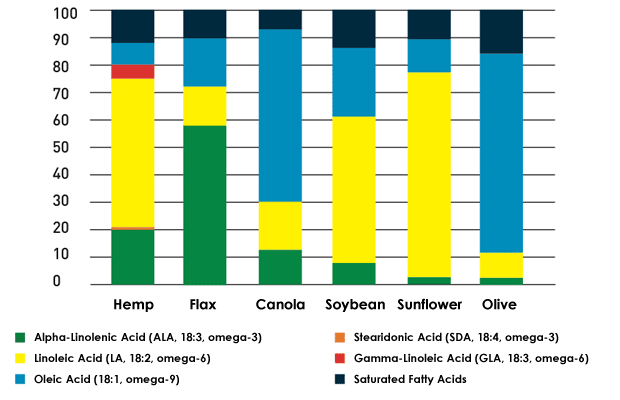
Hemp Seed Oil offers Vitamin E, essential fatty acids, and can be used for a variety of food purposes. With a subtle, nutty flavor, the taste of hemp seed oil lends itself well to dressings and sauces. Hemp seed oil offers the highest amount of Omega-3 and the most desirable ratio of LA (omega-6) to ALA (omega-3). Not only does it offer great benefits to the body, but it is also a wonderful skin hydrator and has the ability to relieve severe dryness, and is even helpful with aging skin. With a multitude of health benefits, hemp seed oil is extremely versatile and can be used for food, skin, animals, and can even be used as a wood sealer.
Take a look at the chart comparison below:
Sources:[1] https://www.purti.net/history-of-cooking-oil/#:~:text=It%20all%20began%20when%20people,olive%20oil%20by%203000%20b.c.; [2] https://www.sciencefriday.com/segments/not-all-cooking-oils-are-created-equal/: [3] https://www.fundacion-canna.es/en/nutritional-benefits-of-hemp-seeds